15 Dec 2022 7 MIN READ
How to improve the accuracy of demand forecasting and increase profits? Tips for retailers

The forecast of demand depends on many variables that require analysis: from historical data to external influences. It is quite difficult to take into account all these variables in a changing environment. Meanwhile, inaccurate forecasting entails an increase in unnecessary operating costs, such as logistics, warehouse or financial, and leads to lost sales. In this article, we’re explaining how to improve the accuracy of forecasting.
Specifics of demand forecasting in retail
To improve the accuracy of forecasting in retail, you need to understand the main external and internal factors. Here are the main ones:
Impact of promotional campaigns on assortment
The launch of promotional campaigns contributes to the cannibalization of related products. For example, discounts on products of a higher price category always lead to a decrease in sales in the medium price segment. Therefore, it is important to quantify the demand here in order to ensure the availability of goods for promotional campaigns.
Variability in customer behavior
Sales are closely related to the preferences of buyers. It is difficult to say what the incentive to buy a particular product was: its price, branding, or a bad customer experience with a competitor’s product. A holistic perception of the outlet in the minds of buyers also plays an equally important role. So, as you can see, there are many factors that affect final sales.
General context
The general environment of a particular retailer should also be considered. Here we are talking about existing nearby businesses, taking into account related areas. For example, when going grocery shopping, a person may notice a household goods store and remember the need to buy cleaning products. These factors also influence sales, although it is very difficult to estimate this influence.
Impact of external factors
Seasonality, political situation and economic characteristics affect demand and the accuracy of sales forecasting. Unfortunately, there are no tools that can accurately predict what a business will face in the future, but modern forecasting capabilities help companies respond to changes as quickly as possible.
Brand and marketing
The relationship of a specific SKU with a clear need in the mind of the consumer plays an important role. This is where advertising campaigns and brand development work come to the rescue, which in turn can increase sales by several times.
Location of outlets
Store location is essential in predicting retailer demand. The number of buyers and the relevance of the existing range of goods depend on this.
The methods of traditional manual analysis have long lost their effectiveness to mathematical models based on the use of artificial intelligence and machine learning. This approach not just involves using a certain formula, but improves the accuracy of demand forecasting, taking into account internal and external factors.
How to build a high-quality forecast?
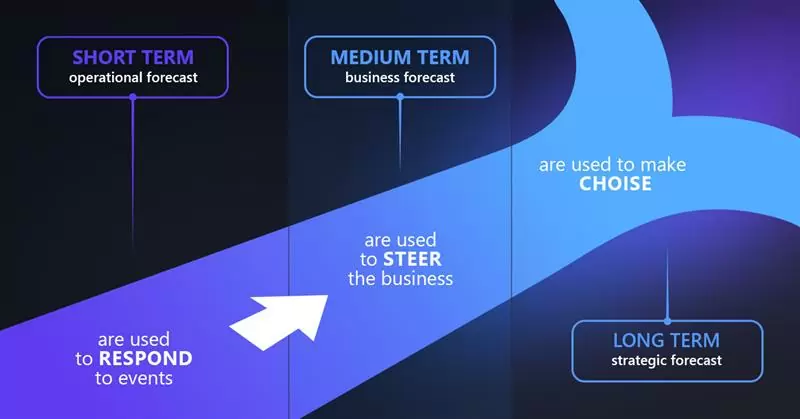
Forecast accuracy is key to inventory management, so each company must forecast demand for different periods of time. Depending on the goals and objectives of the business, there are several types of forecast:
- Short-term or operational: to make quick decisions required by frequent fluctuations in demand
- Medium-term: to manage resources and ensure busines
- s performance
- Long-term: to make strategic decisions on investments and changes in assortment matrices
Using the manual method for all the forecast types described above makes this process inefficient for a number of reasons:
- You depend on specific specialists or project teams.
- Taking into account all the factors in the format of spreadsheets is beyond the power of even experienced professionals.
- Manual methods usually involve the use of a limited number of formulas and methods.
- High probability of human error in forecasts.
To improve forecasting accuracy, retailers delegate complex mathematical forecasting calculations to intelligent systems that can automate this process and make it more efficient through the use of artificial intelligence and machine learning.
The forecasting efficiency and accuracy of these systems is affected by how often you enter new data that is relevant for the calculation. The more high-quality analytical data you provide to the system, the more accurately its mathematical model will work. So if you are just thinking about implementing a system that can improve forecasting accuracy, then we advise you to start working with historical data and demand-correcting factors right now.
What data is needed for the forecast? Let’s take SMART Demand Forecast as an example. This is a system capable of making demand forecasts for both permanent and promotional sales.
The recipe for the necessary data that retailers should structure and accumulate for a successful forecast is as follows:
- Sales history
- Detailed information about promotions (type of promotion, its time frame)
- Prices
- Marketing activities
- Hierarchies of products and points of sale
- Information about competitors (type, geography, etc.)
The absence of some of the above data may affect the forecast accuracy. But this does not limit you in terms of implementing SMART Demand Forecast. To get more information about the benefits and capabilities of the solution, fill out the form.
With companies that are ready improve forecasting accuracy, we launch a pilot project that involves:
- Developing a plan, setting goals
- Describing business processes
- Adapting all data to a single structure
- Running the model on some of the SKUs, which will allow the retailer to evaluate the accuracy of the forecast
This is followed by a stage of full-scale testing of the solution, at which SMART Demand Forecast is integrated and deployed. The final step is the application of system algorithms for the entire range of products and points of sale. Depending on the wishes of the customer, in the future the project can be transferred to the SMART business specialists for technical control or implemented on the customer’s side.
The impact of forecasting on key business indicators
A high-quality forecast is necessary for better control and management of the supply chain: inventory planning, improving the logistics component and enhancing customer experience. Other advantages of accurate forecasting include:
Reducing overstock
The write-off of surplus goods is not only lost profits, but also unplanned disposal costs. To avoid this, it is necessary to work on improving the accuracy of demand forecasting.
Improved goods turnover
Accurate forecasting helps reduce excess reserves. This improves product turnover and frees up frozen cash.
Increasing sales
A high-quality forecast will ensure the necessary level of product availability on the shelves, which will lead to regular sales without the threat of out-of-stock.
Strategic focus and reduced staff costs
Demand forecasting systems take over almost all the mechanical work. This will allow current analysts to focus on more strategic tasks, and the company will not have to spend money on attracting new specialists.
Therefore, an accurate forecast stimulates positive changes in many business indicators. A forecast based on artificial intelligence and machine learning takes into account more components affecting demand and speeds up the process of making managerial decisions in a company.
To get a personal consultation on SMART Demand Forecast, fill out the form.