06 May 2026 29 MIN READ
McDonald’s Georgia: Valuable Business Lessons from Experience in AI-Driven Demand Forecasting
“Just as electricity transformed almost everything 100 years ago, today I actually have a hard time thinking of an industry that I don’t think AI will transform in the next several years,” — Andrew Ng.
Today, these words from one of the world’s leading AI experts sound like a rational explanation of what is already happening in the business environment. Companies are increasingly viewing AI not as an experiment or a technological trend, but as a tool for improving operational predictability. This is especially true for industries with high demand volatility and complex supply chains — retail, distribution, consumer goods manufacturing, e-commerce, and HoReCa. In these sectors, forecasting accuracy directly affects costs, service levels, and the ability to scale operations sustainably.
The Economic Impact of AI in Demand Planning: From Global Analytics to the McDonald’s Georgia Case
According to McKinsey analysts, the use of AI solutions in demand management and logistics can help companies reduce inventory levels by an average of 20–30%, decrease logistics costs by 5–20%, and optimize procurement costs by 5–15%. This effect is achieved thanks to algorithms’ ability to analyze large volumes of data and take into account significantly more factors than traditional forecasting methods allow.
Almost two years ago, McDonald’s Georgia restaurant chain shared its experience of implementing SMART Demand Forecast from SMART business, which enabled an increase in demand forecasting accuracy across the entire network. Today, as the use of artificial intelligence in planning is gradually moving from the category of innovation to a business necessity, this case takes on a new meaning. In fact, the company began transforming its forecasting processes before AI became a mainstream tool for operational efficiency. In this article, McDonald’s Georgia revisits its experience from the perspective of accumulated practice and shares insights on how AI-based demand forecasting today helps the company maintain operational stability, plan resources more accurately, and scale its business more confidently in a rapidly changing market environment.
The Real Business Cost of Inaccurate Demand Forecasting
When companies talk about demand forecasting, it is often perceived as a matter of analytics, models, or KPIs, notes Artem Stepanov, Product Owner of AI solutions at SMART business.
However, in reality, forecast accuracy is directly tied to business financial results. Even minor errors or deviations can translate into significant operational losses.
Let’s consider two common scenarios:
- Overestimated demand → excess At first glance, this may look like a safe strategy, since products are available and sales are not interrupted.
However, in practice, excess inventory means locked working capital, increased storage costs, and the risk of write-offs due to expired shelf life or shifts in demand. As a result, assets that were meant to generate profit turn into a cost burden.
- The opposite situation — underestimated demand → even more painful Out-of-stock situations directly lead to revenue losses, missed sales, and negative customer experience. In highly competitive industries, this also creates a risk of long-term customer churn, as customers quickly switch to alternatives.
The key insight is that excess and shortage of inventory are not two separate problems, but two extremes of the same process. They share a common root cause — inaccurate demand forecasting. This is why businesses are constantly forced to balance between the risk of overstocking warehouses and the risk of lost sales, searching for an optimal point of operational efficiency.
From an analytical perspective, even a small forecasting error can have a large-scale economic impact. A deviation of just a few percent can lead to hundreds of thousands or even millions in additional costs across logistics, procurement, and inventory management.
Small Demand Changes — Large Operational Fluctuations
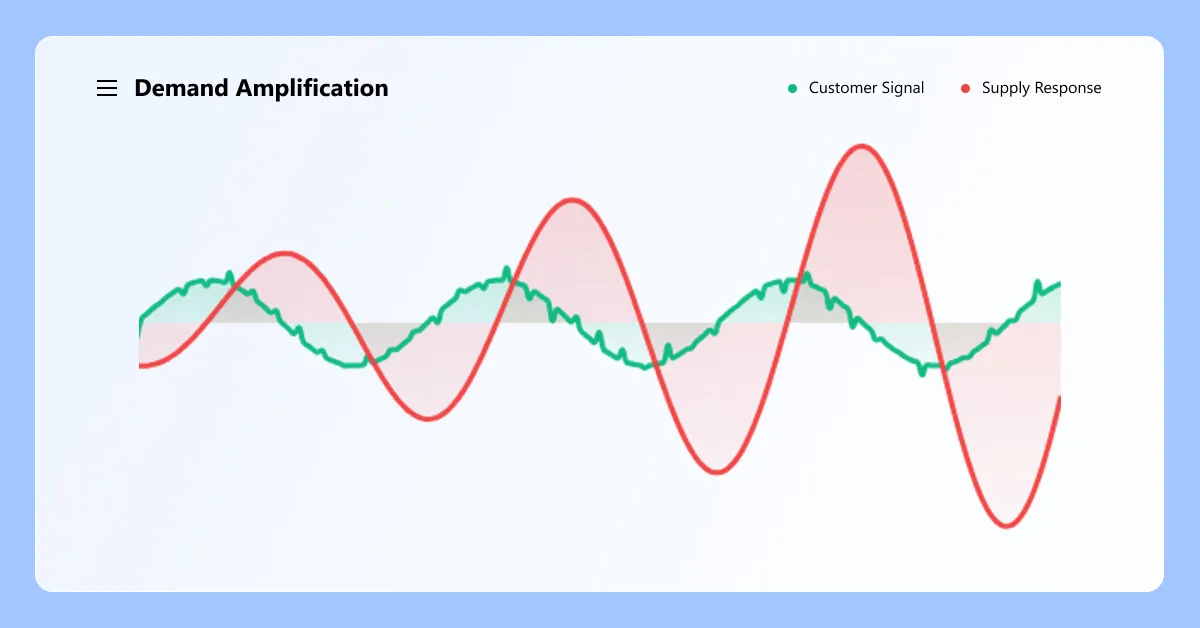
An additional challenge for companies is the ability of operational systems to correctly respond to changes in demand. In supply chains, a phenomenon known as the bullwhip effect is often observed, where small fluctuations in end-customer demand lead to significantly larger fluctuations in production, procurement, and logistics.
Daily sales changes may be random or short-term, but planning systems often interpret them as a stable trend. In response, companies increase or sharply reduce orders in an attempt to compensate for expected changes. This overreaction triggers a cycle of operational instability: warehouses may become overstocked in one period and simultaneously empty in another.
An additional factor is the delay in decision-making and information transfer along the supply chain. The longer the chain, the stronger the amplification of demand variability. As a result, even small fluctuations at the store or restaurant level can translate into proportionally much larger changes in procurement, production, and transportation plans.
For businesses, this means rising transportation and expedited delivery costs, increased volatility in service levels, and greater difficulty in maintaining a stable operating model. Thus, the problem is not demand fluctuation itself, as it is a natural characteristic of any market. The critical question is how quickly and accurately forecasting and planning systems can adapt to these changes without accumulating operational debt.
Operational Debt: When Planning Turns into “Firefighting”
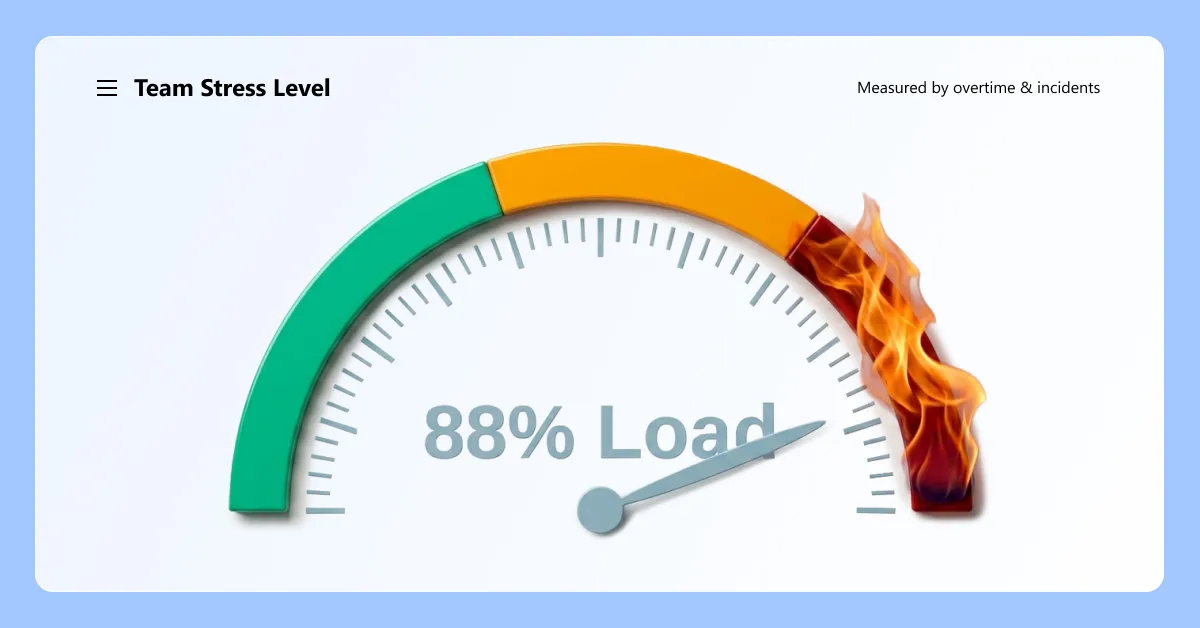
Inaccurate demand forecasting affects not only costs or service levels. Over time, it creates what is known as operational debt — an accumulation of inefficient decisions and fragmented processes that gradually reduce a company’s ability to operate in a stable and predictable way.
In such conditions, planning stops being a strategic function and becomes reactive. Teams are forced to constantly respond to crises instead of systematically optimizing processes and improving decision accuracy.
This most often manifests in symptoms such as the following:
- planning is replaced by a continuous “firefighting” mode, where the main focus is on solving urgent operational issues;
- the number of rush orders and escalations increases (i.e., situations that must be urgently escalated to higher management levels or require additional resources to resolve), which drives up logistics costs;
- decision-making becomes slower due to information overload and process misalignment. When data comes from different sources, it requires manual validation or cross-department alignment, which delays the business response to demand changes;
- stress levels rise within planning and logistics teams, increasing the risk of burnout.
As a result, the business loses both forecasting accuracy and operational agility. Processes formally continue to function, but each new error accumulates and gradually turns into systemic instability. This creates a situation where even small demand changes require disproportionately large efforts to manage.
“Importantly, operational debt does not appear overnight. It is formed gradually — through repeated compromise decisions, manual adjustments, and reactive actions. That is why for many companies the question is no longer whether demand forecasting should be automated, but how quickly the business is ready to move from a reactive management model to a proactive one.”
 Artem Stepanov Product Owner of AI Solutions, SMART business
From Manual Analysis to AI: How Decision-Making Speed Has Evolved
To understand why decision-making speed has become critical for business, it is worth looking at how tools for working with data have evolved. Each era brought its own capabilities and limitations — from manual spreadsheets to integrated systems and modern AI solutions.
Traditional Methods: The Era of Manual Analysis, When Decisions Arrive Too Late
Until recently, most companies relied on spreadsheets as the primary tool for data analysis and planning.
As a result:
- decisions were made with delays of weeks or even months
- data was fragmented and often inconsistent
- analytics answered “what has already happened” rather than “what will happen next”
In practice, businesses operated in a post-fact mode, reacting to events when it was already difficult or too late to influence them.
Connected Era: Faster, but Still Not Enough
The next stage was system integration and the emergence of a unified information environment. Data started to “communicate” with each other, and processes became more synchronized.
This enabled:
- reducing decision-making time to days
- using basic rule-based forecasting models
- automating part of operations, which improved data processing speed
However, even at this stage, businesses remained largely reactive. Systems could process information faster but still could not fully anticipate future developments.
The AI Era: From Reaction to Proactive Action
Today, business is moving into a fundamentally different reality — where the delay between data and decision is almost eliminated.
AI systems are changing the very approach to management. They:
- analyze data in context, taking into account dozens of interconnected factors
- build forecasts based on changes in market and customer behavior
- adapt to changes in real time
- enable proactive decision-making rather than post-fact reaction
In other words, businesses are no longer chasing events — they are starting to stay ahead of them.
What This Means in Practice
The key insight here is simple — today, competitive advantage is defined not by who has more data, but by who can turn it into decisions faster.
In the context of demand forecasting, this means:
- faster response to changes in customer behavior
- reduced accumulation of operational debt
- more stable processes even in a highly dynamic environment
This is exactly where the McDonald’s Georgia experience becomes particularly illustrative. The company has effectively moved to a different decision-making speed.
When Growth Complicates Forecasting: The McDonald’s Georgia Journey
To understand exactly when the need to transition to AI arises, it’s worth looking at a real business context. In the case of McDonald’s Georgia, the key trigger for change was the rapid expansion of the chain.
Since 2019, the number of restaurants has grown by 75% — reaching 28 locations across the country. In practice, this means managing dozens of separate operational units, each with its own demand dynamics, local specifics, and customer behavior patterns. At this scale, traditional forecasting methods were no longer effective enough, and it became clear that the business needed to move toward more modern approaches and tools.
“For us, it all started with a simple question: what exactly are we trying to solve? It came up at the moment when we began seriously considering AI-driven forecasting. Today, our network density is about 1.22 restaurants per 100,000 urban residents. And the faster we grew, the more complex planning became. Maintaining forecast accuracy was getting increasingly difficult, as each new restaurant required a separate approach. When you have a small number of locations, an experienced planner can still ‘feel’ the demand. But when at some point you realize you’re managing not one business, but nearly thirty simultaneously — that’s a completely different game.”
 Giorgi Asatiani Head of BI & Data Analytics, BI & Data Analytics Department, McDonald’s Georgia
Why Manual Methods Failed to Scale
Business growth tends to expose the limitations of manual tools. The most critical ones include:
- Lack of scalability in manual forecasting — maintaining accuracy would have required the company to continuously expand its planning team. In effect, this meant building an “army of analysts,” which directly contradicted the goal of operational efficiency.
- Limited data granularity — working with aggregated, network-level data made it impossible to capture differences between individual restaurants. As a result, decisions were based on “average” indicators rather than real, location-specific insights.
- No external factors in forecasting — manual models largely failed to account for contextual variables such as weather conditions, local events, marketing activities, and more.
As a result, McDonald’s Georgia was operating in a reactive mode rather than a predictive one.
When One Market Means Dozens of Different Scenarios
These limitations became especially evident at the level of individual cities — and even specific restaurants.
“For example, in Batumi, a rainy weekend can sharply reduce the number of drive-thru orders while simultaneously increasing demand for delivery. In Tbilisi, a football match day can create peak load in the restaurant dining area and shift the demand structure within just a few hours. These kinds of scenarios are difficult to predict manually because they depend on a combination of constantly changing factors. And when the number of variables exceeds the capacity of manual analysis, the question is no longer how to optimize the process, but how to rethink it entirely.”
- Giorgi Asatiani Head of BI & Data Analytics, BI & Data Analytics Department, McDonald’s Georgia
Why McDonald’s Georgia Chose a Ready-Made AI Solution Instead of Building One
Once the McDonald’s Georgia team realized that manual forecasting was no longer effective, the logical next question was how exactly to change their approach.
“We were choosing between two scenarios: building our own forecasting system or implementing a ready-made AI solution. At first glance, custom development may seem attractive as an opportunity to create a tool tailored specifically to your needs. However, in reality, this path is much more complex and riskier. That’s why our decision to implement a ready-made solution was driven by a number of specific advantages we saw,” Giorgi explains.
- Speed: When results are needed not “someday” but now, speed becomes the key factor. Developing a custom solution from scratch — even with external contractors — could take several years, just to reach a working prototype stage. Meanwhile, the business needed change “yesterday.”
That’s why McDonald’s Georgia chose an approach that allows them to:
- get initial results immediately after diagnostics
- avoid long development cycles
- move quickly from problem to tangible impact
In essence, this meant a shift in mindset: not building a tool but obtaining results.
- Focus on core expertise: The restaurant business ≠ AI development. McDonald’s is a hospitality business, not a software developer. While the team has strong analytical expertise, building and maintaining ML models requires additional specialized skills. Moreover, the work does not end once a model is created. It requires:
- continuous monitoring
- regular retraining
- ongoing support and development
In other words, it effectively requires a dedicated machine learning team. In this context, the ready-made SMART Demand Forecast solution enabled the company to:
- focus on business growth rather than maintaining AI systems
- concentrate on using insights instead of developing tools
- gain access to already established expertise
- Flexibility and future readiness: In the QSR (quick service restaurant) industry, demand is shaped by dozens of variables, including:
- seasonality
- promotions
- weather conditions
- sales channels
- local events
That’s why McDonald’s Georgia needed a system that:
- can already handle these dependencies out of the box
- continuously learns from new data
- adapts to changes without requiring a complete rebuild
This became one of the decisive arguments in favor of the ready-made SMART Demand Forecast AI solution.
- Less development — more business value: By implementing a ready-made solution, the McDonald’s Georgia team was able to:
- work with forecasts rather than models
- focus on planning and decision-making
- leverage a wide range of capabilities that would have required significant resources in a custom development scenario
“We needed results in months, not years. A long development cycle always carries the risk of losing touch with reality: by the time a custom model is ready, the restaurant network, demand structure, and even sales channels may have already changed the rules of the game. That’s why it was critical for us to implement a solution that delivers results here and now, without slowing down the business,” Giorgi emphasizes.
In other words, technology stopped being a project and immediately became a working tool.
“The McDonald’s Georgia case clearly illustrates a shift in approach that is becoming increasingly common today: companies are no longer striving to own the technology — they aim to extract value from it as quickly as possible. In this context, the choice between a custom solution and a ready-made product is not about tools. It’s about speed, focus, and the business’s ability to adapt to change — and that’s exactly what the SMART Demand Forecast solution enabled.”
- Artem Stepanov Product Owner of AI Solutions, SMART business
How AI Turned Forecasting into Actionable Decisions
In the case of McDonald’s Georgia, AI became part of a closed-loop demand management system — where data, forecasting, and operational decisions function as a unified whole.
From Fragmented Data to a Complete Picture
Any forecasting starts with data. But in real business environments, it is rarely perfectly structured.
“The importance of a solid data foundation should not be underestimated. High-quality, clean data is the key to success for any project like this. We were fortunate: six years ago, we consciously invested in developing our data infrastructure, and by the start of this project, it was already at a high level. At the same time, this case required much deeper granularity. New types of data emerged that we had simply not tracked before. This forced us to revisit some of our assumptions, rethink how certain metrics are defined, and ensure consistency of historical data,” Giorgi explains.
At McDonald’s Georgia, this meant working with a set of diverse signals:
- sales data from POS systems
- shipment data
- promotional activities
- weather conditions
Individually, each of these factors provides only part of the picture. But together, they create the context in which real demand emerges.
The AI within SMART Demand Forecast makes it possible to combine these fragmented data sources and work with them as a single system — without losing detail or local nuances.
As the project team emphasizes, the model is not a “black box.” Every stage — from data integration to factor consideration — remains transparent and controllable.
The “Brain” of the System: How the AI Model Works in SMART Demand Forecast
The next level is the model itself, which transforms data into forecasts. And here, not only accuracy matters, but also how manageable and interpretable the process is:
- The model is regularly retrained on new data.
- It accounts for dozens of variables—from weather to promotional effects.
- It allows users to understand why the forecast looks the way it does.
This is critically important for business. Trust in a forecast is built not only on numbers, but also on understanding the logic behind them.
What Matters Most — Execution
The real value of AI lies not in the model itself, but in how its results are used. At McDonald’s Georgia, forecasts are directly embedded into core business processes:
- sales and operations planning (S&OP)
- production scheduling
- inventory management
- procurement
In other words, the forecast is automatically translated into concrete actions. As a result, analytics is no longer a standalone function — it becomes an integral part of the operational cycle.
“A forecast only has value when it changes decisions. Even the most accurate model remains just analytics if it doesn’t impact the weekly planning cycle. When forecasting becomes part of the process, it’s not just accuracy that improves — the entire logic of how the business operates changes: the number of urgent orders and ‘firefighting’ decisions decreases, the risk of excess inventory is reduced, service level stability improves, and planning becomes more predictable.”
- Giorgi Asatiani Head of BI & Data Analytics, BI & Data Analytics Department, McDonald’s Georgia
What the AI Implementation Journey Looks Like in Practice
Another key takeaway from the McDonald’s Georgia case is that transitioning to AI is not a one-time transformation, but a step-by-step process. A crucial role in this process is played by building the right foundation:
- Data as the starting point: The first and most critical stage is working with data. Together, the SMART business team and McDonald’s Georgia built a unified structure that includes:
- sales history
- restaurant characteristics
- external factors
- promotional activities
- product life cycles
- even specific rules (such as the COVID-19 period)
This may seem like “basic work,” but it determines the quality of all subsequent steps. If the data is unstructured, even the best AI will produce flawed results.
- A unified data logic across the business: The next step was adapting the client’s data to an existing universal structure that is clear to different departments. This made it possible to:
- align perspectives across teams
- avoid data conflicts
- operate with a single version of the “truth”
- Omnichannel as a must-have condition: For McDonald’s Georgia, one of the key challenges was multichannel approach. Demand is shaped not only at the product or restaurant level, but also at the channel level:
- dine-in
- drive-thru
- delivery
Therefore, the system was designed to capture the business across all these channels simultaneously.
“Each sales channel has its own demand rhythm. For example, drive-thru orders are fast and impulsive. Delivery typically involves a higher average check and is much more sensitive to weather or local events. Dine-in service is a more stable and predictable channel. Initially, we worked with aggregated data in Excel at the system level. But at the level of individual restaurants, this effectively meant operating ‘blind.’ Excel can still be a useful tool, but it cannot account for external signals such as weather, local events, or the ripple effects of marketing campaigns. That’s exactly where SMART Demand Forecast became the solution that allowed us to see the real demand picture in all its complexity.”
- Giorgi Asatiani Head of BI & Data Analytics, BI & Data Analytics Department, McDonald’s Georgia
- Pilot and system training: Before full deployment, the model goes through a testing phase:
- forecast accuracy is validated
- anomalies are identified
- calibration is performed
- Scaling and a new team role: After implementation, the forecasting process changes fundamentally. As noted by the McDonald’s Georgia team:
- up to 90% of operational work is handled by the system
- the team focuses on validation and decision-making
- the focus shifts from routine tasks to a strategic level
In effect, AI did not replace people — it transformed their role.
AI “Under the Hood” in SMART Demand Forecast: From Raw Data to Management Decisions

SMART Demand Forecast is an end-to-end software solution built within the Microsoft ecosystem — from data integration to analytics in Power BI. If you break it down into components, the core logic becomes clear: minimize the human factor where it creates errors and amplify it where expertise is needed.
Data as the Foundation: Why AI Doesn’t Work Without It
“Any forecasting starts not with algorithms, but with data. And there’s a simple but critical truth that is often underestimated: garbage in — garbage out. If poor-quality or chaotic data enters the system, the results will be just as flawed or useless. Output quality always directly depends on input quality.”
- Artem Stepanov Product Owner of AI Solutions, SMART business
That’s why the first stage in SMART Demand Forecast is not “AI magic,” but rather systematic groundwork:
- automatic data quality analysis — the system detects gaps, errors, and inconsistencies
- historical sales data cleansing — separating real demand from noise
- identification of trends and seasonality
At this stage, AI acts not as a forecaster, but as a data “clean-up” mechanism.
The Core Engine: Where Real AI Comes In
Once the data is structured and cleaned, the next phase begins — what is typically referred to as AI, though in practice it goes far beyond a single model.
At the heart of SMART Demand Forecast is an ML engine that:
- automatically selects the best model for a specific business case
- works with both regular demand and promotions (including cannibalization effects)
- continuously retrains on new data
But its real strength lies in the details:
- Solving the “no history” problem with New products or new locations are one of the most challenging aspects of forecasting. This is a global issue: when there is no historical data, there is nothing to base a forecast on.
SMART Demand Forecast addresses this through an analog-based approach:
- the system identifies and allows selection of similar SKUs or restaurants
- builds forecasts based on their behavior
- adapts them to the new context.
This allows the business to move from guesswork to data-driven scenarios.
- Anomaly control instead of Sharp spikes or drops in demand are common in any business. The key question is how to interpret them. In this case, the SMART business solution:
- automatically detects anomalies (using approaches such as the 3-sigma rule or ML algorithms)
- suggests smoothing options
- allows users to confirm or adjust them
This is a critical point: AI does not “decide instead of humans” — it highlights where human intervention is needed.
- Scenario Modeling: Testing Decisions Before They Go This capability is about working with the future rather than only predicting it. For example:
- what happens if a 50% discount is applied on Friday instead of Monday
- how demand changes when a new product is launched
- how multiple promotions interact when running simultaneously
This is the real shift from forecasting to demand management.
When Complex Mathematics Turns into Decisions
It is also important to understand how the output looks from a business perspective. All calculations are translated into clear, actionable analytics:
- How much the forecast can be trusted — the system shows accuracy levels and helps assess risks before decisions are made.
- Where the forecast consistently fails — bias monitoring helps identify systematic distortions (for example, persistent under- or overestimation of demand).
- What this means in financial and operational terms — analytics shows the impact of forecasts on inventory, product availability, and potential losses or overstock situations.
The key point is not that the system “does calculations,” but that managers can see cause-and-effect relationships and use them directly in decision-making — from procurement to promotion planning.
Why SMART Demand Forecast Is Not “Rocket Science,” but a Daily Tool
The system is designed to be practical and easy to use, providing several key advantages:
- A web application accessible via a corporate account;
- A clear workflow: upload data → select period → handle anomalies → train model → process promotions and analogs → generate forecast;
- Visual charts showing the difference between raw and cleaned data;
- The ability to quickly apply corrections and immediately see the impact.
The combination of high-quality data + AI + human control transforms forecasting from retrospective analytics into a forward-looking decision-making tool.
McDonald’s Georgia Results That Changed the Rules of the Game
The McDonald’s Georgia team notes that planning accuracy has improved at all levels. But what matters most is where this improvement became visible.
A New Level of Granularity for Business
Where forecasting previously operated at the level of the entire network or large segments, it now delivers accuracy at the level of individual restaurants:
- the 4-week-ahead forecast matches reality with 83% accuracy for each individual location
- for products that account for 70% of sales, accuracy exceeds 85%, which is a critical metric for many business areas, especially supply chain management
“Such high indicators mean that we are now seeing real demand behavior — not averaged, but local. For example, the difference between a restaurant in the city center and one on a highway — something that used to be lost in aggregated data. We can dive into channel structure or operate strictly at the level of an individual restaurant, depending on the task. This level of forecasting was previously unimaginable. And it significantly increases our confidence in operational decisions.”
- Giorgi Asatiani Head of BI & Data Analytics, BI & Data Analytics Department, McDonald’s Georgia
Growth No Longer Requires Proportional Team Expansion
Despite scaling the network, McDonald’s Georgia managed to avoid expanding their planning team. In practice:
- the system handles up to 90% of analytical work
The remaining 10% is local context added by the company — because even with rapid AI development, the human factor remains essential, especially in a business where customer mood and behavioral nuances strongly influence demand
- forecasts are no longer created manually — they are generated and updated automatically
- the team’s role has shifted from building forecasts to validating and controlling them
“In fact, the process is still overseen by a single experienced planning manager. But while they used to build forecasts manually, now they review, adjust, and make decisions based on ready-made models. The system operates continuously, 24/7, analyzing data, tracking changes, and adapting forecasts to new conditions — without the need to expand the team,” Giorgi explains.
AI-driven forecasting has allowed McDonald’s Georgia to shift focus — from routine operations to higher-level decision-making. As a result, this creates an entirely new level of business planning that is already being felt across different company functions.
The platform is built on a continuous learning cycle. McDonald’s Georgia uploaded historical sales data starting from 2020, and with each new update, the system goes back 24 months and retrains the model. This ensures that forecasts are always based on up-to-date data while still accounting for historical trends and patterns. And all of this happens “behind the scenes.” As a result, the company gains flexibility and can focus on planning and decision-making — rather than the technical aspects of building models.
Gaining Control Over What Used to Be a “Blind Spot”
Forecast granularity at the level of individual restaurants, sales channels, and even “product–channel” combinations highlights problem areas in demand and sales that were previously lost in aggregated figures.
“We are a multichannel business, and it was important for us to have a solution that allows us to analyze demand not only at the level of restaurants and products, but also across sales channels. However, if we talk about the challenge, it was more on the developer’s side than ours. We only needed to clearly define the requirement — after that, the SMART business team took over the complex part. They went deep into understanding how our business actually works, not just the numbers. We went through several validation cycles together to ensure that the model’s results reflect real demand behavior across different channels,” Giorgi noted.
Improved Collaboration Across Teams
Another important outcome is a qualitative shift in internal coordination. This is not just about making work “more convenient,” but about changing the very logic of interaction.
- Faster communication — previously, aligning decisions often required additional explanations: where the forecast came from, why those specific numbers, what assumptions were used. Now these questions disappear, as everyone works with the same data and sees the same picture. This significantly reduces discussion time and allows teams to move to action faster.
- A single understanding of data and demand across all levels — operations, marketing, supply chain, and top management no longer view the business through different “versions of the truth.” The AI model creates a unified forecasting baseline that is interpreted consistently by everyone. As a result, situations where departments rely on their own calculations or assumptions are eliminated. Everyone now operates within a shared context.
- Increased trust in team decisions — when forecasts consistently demonstrate high accuracy at the level of individual restaurants and channels, they stop being a “hypothesis” and become a reliable decision-making tool. This changes team behavior: instead of relying on intuition or “playing it safe,” the business starts acting more confidently and proactively.
“Ultimately, AI-driven forecasting powered by SMART Demand Forecast has become a common language for our business — from the operational level to top management. And this is what allows the company to move faster: not wasting time aligning on reality, but working with it right away,” Giorgi concludes.
If you also want to manage demand without blind spots in decision-making and adapt to market changes quickly and effectively, SMART Demand Forecast will help you gain a transparent view of your business future today. Request a consultation, and the SMART business team will help you implement AI-driven forecasting — from data collection to integrating results into operational processes.